During the 19th century, the rapid development of motor technology played a decisive role in technical and scientific progress, from the Industrial Revolution to the birth of modern transportation systems. In this historical context, predominantly dominated by steam engines, the internal combustion engine was also conceived and progressively perfected. Unlike steam engines, which consist of external combustion systems in which water vapor is used as the energy carrier, in the internal combustion engine all energy transformations, from the chemical energy of the fuel to the mechanical energy, are achieved in a single machine that uses air as the carrier. Without a steam generator and other bulky devices, the internal combustion engine is more compact and lightweight, which is why, over the course of its evolution, it has become the most convenient and prevalent system in almost all areas of use, especially in modern means of transportation and in most industrial applications, with the exception of large thermoelectric power plants. Between the end of the 18th century and the first half of the 19th century, some scholars and inventors became interested in internal combustion systems, from Alessandro Volta's pistol with the combustion of a gas mixture ignited by an electric arc to the construction of rudimentary machines, such as the one proposed by the Frenchman Fraçois Issac de Rivaz in 1804.
The first to successfully build an internal combustion engine with continuous and automatic operation were Eugenio Barsanti and Felice Matteucci of Lucca. Starting with the first atmospheric prototype in 1853, they refined their invention, producing engines with different construction characteristics, which were described in various publications, technical certifications, and patents. Barsanti and Matteucci entrusted the construction of their engines to various engineering companies, not only Italian ones, including Escher Wyss of Zurich. Over the years, they dedicated themselves to promoting their engines, receiving various awards, and attempted to launch mass production for commercialization in various countries. Barsanti's death in 1864 and Matteucci's failing health put an end to their activity, just as other inventors were successfully building and marketing their engines. The most technically and commercially successful were the Germans Nikolaus Otto and Eugen Langen, whose fame long overshadowed the originality of Barsanti and Matteucci's invention.
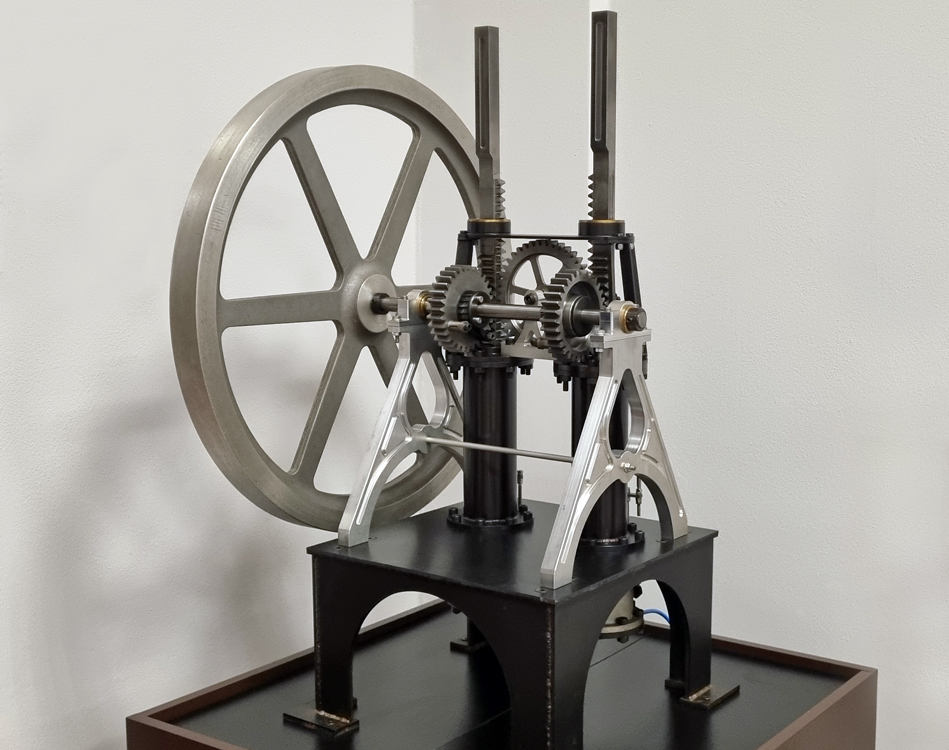
The memory of this historic event is today protected by the Barsanti and Matteucci Foundation and the Internal Combustion Engine Museum in Lucca, named after them, through numerous promotional activities and collaborations with numerous public and private entities, including the Museo Storico dei Motori e dei Meccanismi. This includes the display on loan of the scale model of the first engine designed by Barsanti and Matteucci, as part of a collaboration agreement that began in 2025. As evidenced by several invoices and letters from the Pietro Benini company of Florence, the first prototype of Barsanti and Matteucci's engine was built in 1853 for experimental purposes. To protect their results, Barsanti and Matteucci requested and subsequently obtained a first protection certificate, No. 1072, in the United Kingdom in 1854. In 1856, an engine compliant with this document was built and used in the mechanical workshops of the Maria Antonia Railway in Florence to power a pair of scissors and a drill. The original engine has not been preserved, and the scale model on display represents its construction. For display purposes, it is operated with compressed air.
Click here to listen to the audioguide on izi.TRAVEL
Click here to discover more on the website of the Barsanti and Matteucci Founfation
Operating operating machines, in particular a pair of scissors and a drill, in the mechanical workshops of the Maria Antonia Railway in Florence.
Courtesy of the Barsanti and Matteucci Foundation of Lucca.