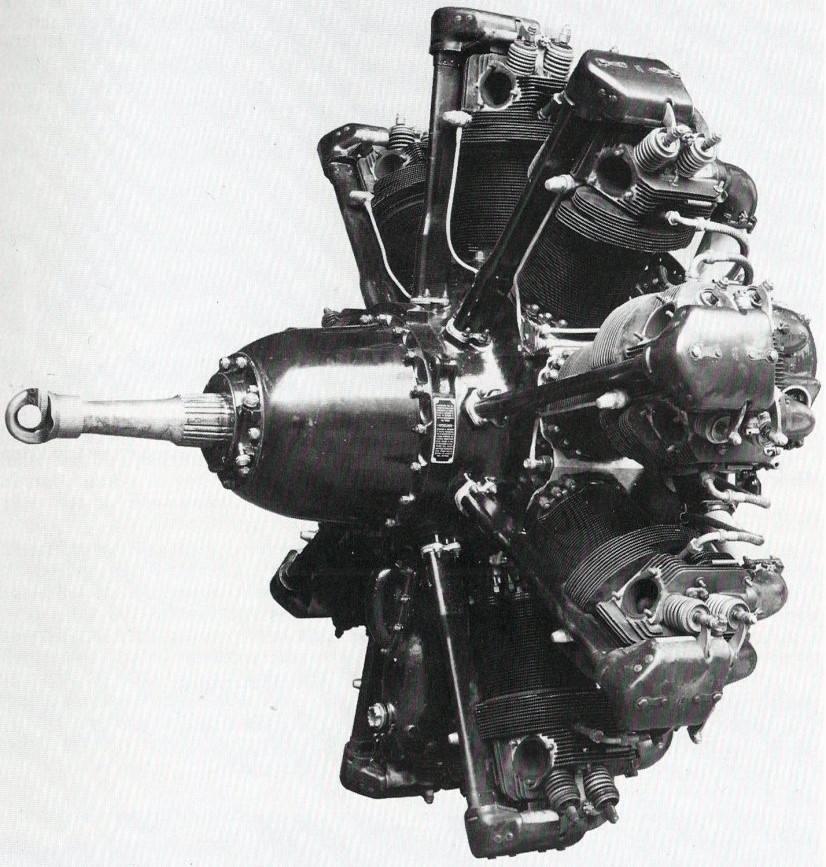
The Alfa Romeo 126 was one of the most widely used aero engines in Italy from the mid-1930s until the end of the Second World War, powering almost all large multi-engined aircraft of its time. It was developed as an evolution of the model 125, retaining the same basic design: a nine-cylinder, air-cooled radial engine derived from the British Bristol Pegasus, for which a production licence had been acquired. Compared with the 125, Alfa Romeo introduced a number of modifications in the 126 aimed at improving performance and overall reliability. These included changes to the fuel system and the supercharger, which operated at higher pressures than those of contemporary engines from competing manufacturers. The 126 was produced in two versions: the R.C. 34, capable of delivering 750 hp at 3,400 metres above sea level, and, in smaller numbers, the R.C. 10, optimised for low-altitude operation, producing 800 hp at 1,000 metres. From the 126, Alfa Romeo derived several closely related engines incorporating various design and performance improvements, ranging from the model 127, intended for high-altitude use, to the more advanced and complex 131, which produced 940 hp. With appropriate modifications, the 126 was also used in a number of international competitions. Notable achievements include the seaplane distance record set by a Cant Z.506 B in 1937, and numerous successes with the SIAI-Marchetti S.M.79, including victory in the Istres–Damascus–Paris race in 1937 and the Rome–Dakar–Rio de Janeiro flight in 1938, completed at an average speed of 400 km/h.
Click here to listen to the audioguide on izi.TRAVEL
CANT Z 506
Caproni A.P.1 (Ca. 307)
SIAI Marchetti S.M. 73, S.M. 74, SM. 75, S.M. 79, S.M. 81, S.M. 83
Courtesy of the Historical Museum of the Italian Air Force, Vigna di Valle (Bracciano, Rome)