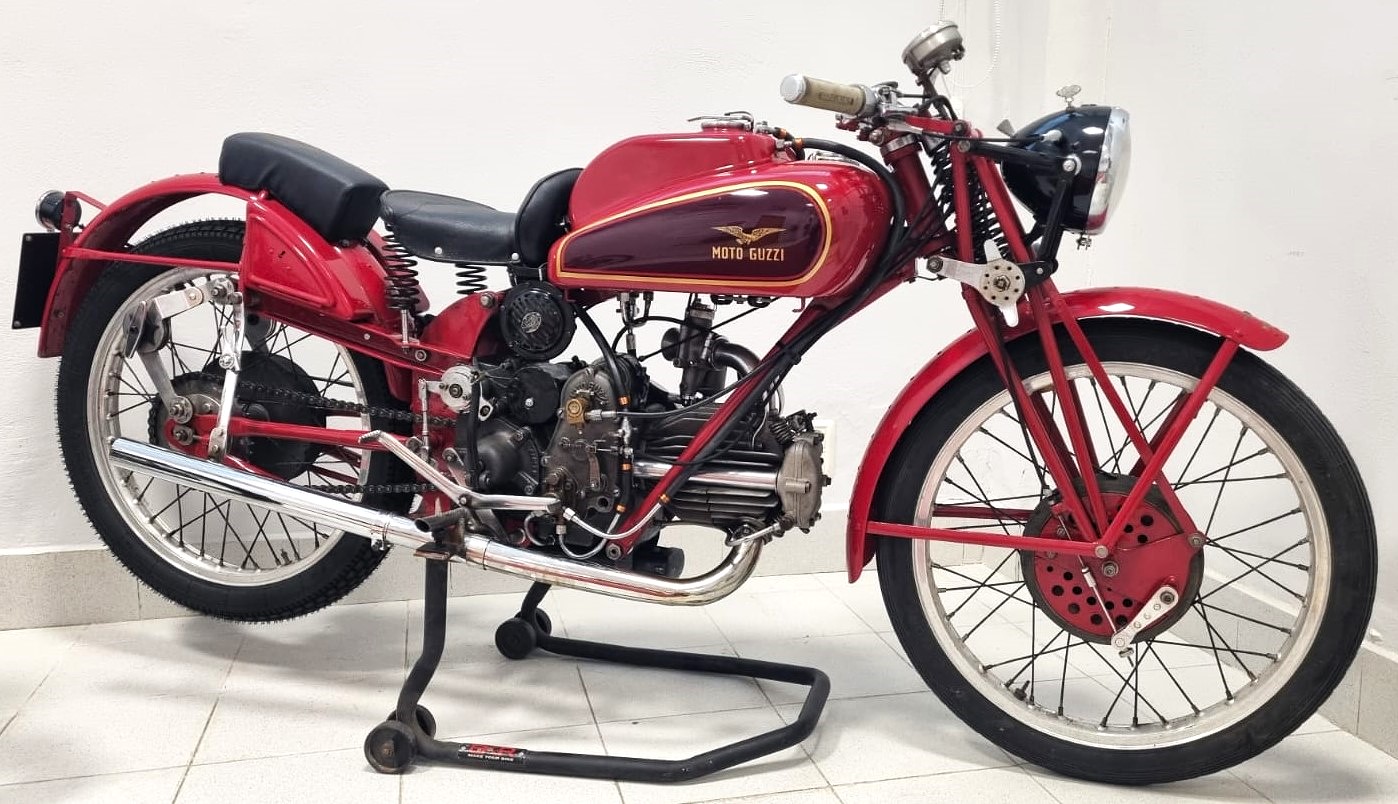
Developed in the late 1930s, the Moto Guzzi Condor was a competition motorcycle for the 500 cc class, designed to perform effectively in both circuit racing and road events. In this type of competitive context, lightness, stability, and ease of handling could influence results as much as—if not more than—outright maximum power. The Condor project was undertaken by Giulio Cesare Carcano, who developed a machine derived from existing models in the company’s range, with the aim of producing a motorcycle that was competitive yet at the same time simple, robust, and suitable for use by private riders. The Condor adhered to Moto Guzzi’s established engineering tradition of the period. It was equipped with an air-cooled, horizontal single-cylinder four-stroke engine, featuring overhead valves actuated by an overhead camshaft driven via a bevel gear train. This design configuration, inherited from earlier Moto Guzzi sporting models, offered a sound balance between mechanical reliability and overall performance. The effectiveness of the project was also demonstrated in competition, with several notable successes, including victory in the 500 cc class at the Circuito del Lario in 1939, followed in 1940 by first place in the Milano-Taranto, achieved at an official average speed of 103 km/h. Although its competitive career was curtailed by the war, the Condor remains a significant example of a racing motorcycle conceived according to principles of functionality, balance, and practical efficiency. This approach was subsequently carried forward in the development of the Moto Guzzi Dondolino, which inherited its sporting legacy.
Click here to listen to the audioguide on izi.TRAVEL
Motorcycle on temporary display, made in collaboration with the Associazione Siciliana Veicoli Storici - ASI